



Right before another deadline, which was due to expire at 8PM EST on Tuesday, Donald Trump announced a two-week ceasefire agreement with the Iranian regime, brokered by Pakistan with a last-minute intervention by China:
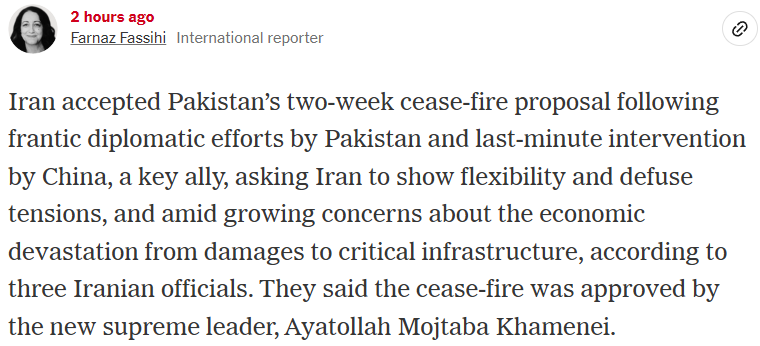
The agreement followed Trump's increasingly intense rants, telling Iran to "open the f... strait" and a threat that "an entire civilization" will be wiped out if there is no deal.
As ever, Trump's pseudointellectual armchair critics, who have spent their entire lives talking about everything but accomplishing nothing, accused him of genocidal fantasies and an open admission of an intent to commit war crimes – though their criticism of the Iranian regime mass-murdering tens of thousands of protesters a few weeks ago was rather muted.
And, as usual, Trump's bluster worked in the end, even though we're still quite far from the war's conclusion.
Iran caved under pressure, seeing that it was abandoned by the only backer that could throw its weight behind it against the US – China. Beijing, it seems, has had enough of the escalation, which has triggered a global energy crisis, affecting its own, usually dirt cheap, oil imports from Iran.
Small but meaningful victory for Trump
Both sides are going to benefit from the ceasefire, which is going to provide some respite for American troops as well as IRGC apparatus relegated to hiding in bunkers and tunnels carved into the mountains.
However, Iran's apparent reluctance is understandable, as the cessation of hostilities helps the Americans – operating thousands of miles from home – more.
Iran's only remaining leverage in this war is its control over the strait of Hormuz, whose blockade has pushed global oil prices over $100 per barrel and become a political issue for Trump in a midterm election year.
Militarily the regime is in ruin, reduced to being a disruptive terrorist group capable, at most, of launching a handful of attacks on soft, civilian targets in neighbouring countries.
The nation of 90 million people, with 2500 years of continuous history, is acting like its battered proxies Hamas and Hezbollah.
Both sides have now received two weeks to regroup and prepare for another chapter, should the agreement be impossible – which it very much appears to be, given the 10-point demands that are to be the framework for the talks.
But Iran has clearly got the short end of the stick, given that its damaged industrial base cannot provide the IRGC with any military boost in such a short timeframe.
Meanwhile, there's a third US aircraft carrier on its way from America to the Middle East, which should arrive just in time for the late April deadline.
A pause in fighting also permits the US to replenish its munitions or ship missile interceptors to its allies in the region, while American soldiers enjoy some well-earned rest – all of that as Iran can only sit back and watch.
Overnight, Tehran has lost all of its leverages, while its enemies received a break to prepare for round 2.
Wearing the Americans down with high oil prices, materiel depletion and exhaustion from thousands of sorties carried out by troops in the Arabian and Red Seas was the only survival strategy the regime had.
It is now going to be forced to negotiate under pressure of more American soldiers and weapons converging on the Gulf, while it can do nothing similar in response.
And it's China that forced it into this position.


